Showing posts with label 2001 ≡ 2╂1 ≡ 3. Show all posts

Thursday, May 15, 2014

Kubrick Cut By Cut: ASO001 to ASO120
– 2001: A SPACE ODYSSEY
– 1. Act: THE DAWN OF MAN

Warning: Spoilers ahead! This post contains furthermore copyrighted material for the purpose of research, commentary and eduction as per fair use provisions.

This is first instalment of my "Kubrick Cut By Cut" series for Stanley Kubrick's film 2001: A Space Odyssey. In this post I will cover the first act with its twenty minutes – the "prehistoric" scenes – plus the short one minute Entr'acte that serves as a bridge to the second act.

Going cut by cut (and making notes as to the time of the cut) allowed me to discover some important hints which helped me to better understand the film, and Kubrick's mode of work.

The first thing I want to highlight is how methodical Kubrick is: A casual viewing of the first act might give the impression that we are simply seeing one long unstructured narrative being played out on the screen. However, after the notes I took so far, I can say that Kubrick has clearly structured the first act:
  • 1. Act: THE DAWN OF MAN (Twenty minutes in four settings)
    • 1. Setting: The Formation of the Solar System (Five minutes)
    • 2. Setting: Huminids: Animals among Animals (Five minutes)
    • 3. Setting: The first Monolith (Five minutes)
    • 4. Setting: Tools and the first Murder (Five minutes)
  • Entr'acte: (SPACE) BOMBS (One Minute) 
Furthermore I suspect that the settings are further structured by the cuts, e.g. that the 1. setting is divided into the time pre Solar System – aka Formation of the Universe – and the actual Formation of the Solar System. For a lack of time I have not investigated this any further, but I may revisit that question once I have noted all cuts in the film.

The second thing I want to highlight is that Kubrick does place his cuts with care. Four individual cuts stand out in the first act, which each cut marking the end of a setting, and the beginning of the next setting or the entra'acte – I will refer to these cuts as "delimiters":
  • 1. Delimiter: 0:05:02 (cut ASO009)
  • 2. Delimiter: 0:10:00 ("audio-cut" ASO049)
  • 3. Delimiter: 0:15:01 (cut ASO073)
  • 4. Delimiter: 0:19:53 (cut ASO117)
What immediately stands out: While the ten minute delimiter (an "audio-cut") is "on the mark", the other three delimiters are not. One is 2 seconds "late", the other 1 second late, and the last is 7 seconds "early" (but the cuts are "precise" in so far as they seem to fall exactly on their respective second, as far as I can tell).

What is the meaning of the cut-times? With regards to the last cut-time (ASO117), I have good reason to believe that Kubrick is making a reference to the year 1953.

With regard to the first delimiter and the third, I think Kubrick is highlighting the number "2" and the number "1", which together make the number "3". Later on in the film we will see other examples were Kubrick shows a set of 3, made up of 2 similar and 1 slightly different element – e.g. 3 buttons on a pen, 2 of which are white, and 1 is red (ASO125-01). By the way, this ties in nicely to the title of the film.

The time of other cuts so far may be important as well, however I again lack time to do this now, and would rather first transcribe all cuts in the film.

And the last thing I want to highlight for now is that there is a scene 114 in this film – ASO114 here – which holds special, pivotal meaning, and quite likely that there is a scene 114 in other films by Kubrick as well.

Some notes: I make mistakes – maybe even here. With regards to the number of cuts in this sequence, I found two mistakes before publishing – there may be still mistakes lurking here.

So, let the games begin. (And in my next life I'll rather choose to do Hitchcock's Rope…)

1. Act: THE DAWN OF MAN (Twenty minutes)

1. Setting: The Beginning of the Solar System (Five minutes)

ASO001 (0:00:00) Black screen, music


Extraordinary:

ASO001-01:

And in the beginning there was darkness – we are witnessing the formation of the Solar System.

ASO001-02

Music begins at 0:00:04 and ends at 0:02:52. (Possibly two more cuts to be counted.)

ASO002 (0:02:58/N) MGM logo

Extraordinary:

ASO002-01

The ignorant Renata Adler asserted quite rightly (in what was possibly her only bright remark on the film): EVEN the M-G-M lion is stylized and abstracted in Stanley Kubrick's "2001: A Space Odyssey.

As we are witnessing the creation of the Solar System, the MGM logo symbolizes either the Sun, or possibly the disc of the entire Solar System. In the beginning there was darkness, now there is light. The beginning of the film symbolizes literally the beginning of time. Stanley Kubrick is giving us an highly artistic allegory about the beginning of the Universe and of the Solar System, and Renata Adler is shouting from the peanut gallery: "BORING!"

ASO003 (0:03:07/FO/~2sec) Fade back to black


Extraordinary:

ASO003-01

Crossfade starts at 0:03:06. 36, 63?


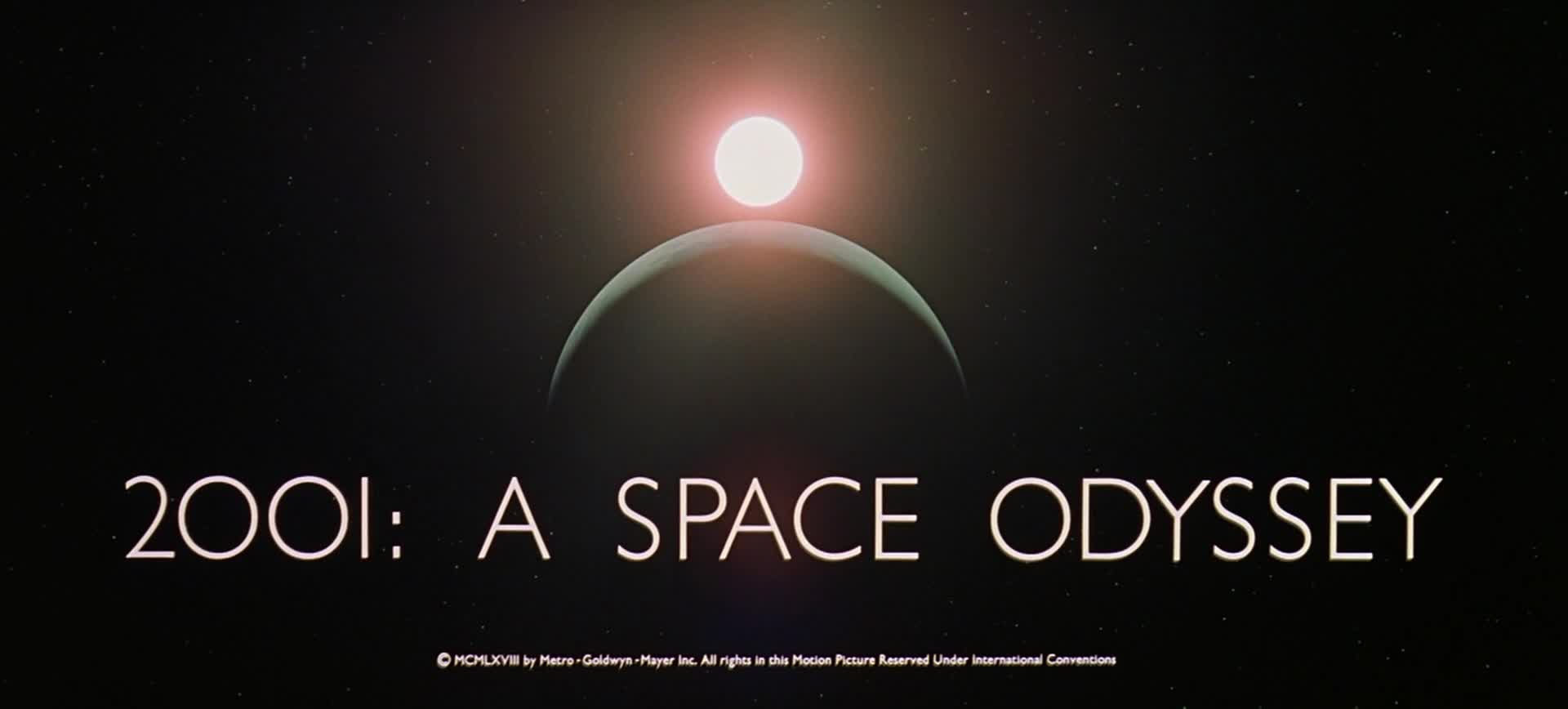
ASO004 (0:03:15) Thus spoke Zarathustra – Moon, Earth, Sun aligned – Title


Extraordinary:

ASO004-01

Black screen from 0:03:15 to 0:03:17 – Moon fades in at about 0:03:17. (Possibly one more cut to count.)

ASO005 (0:04:28/FO/~2sec) Fade to black


ASO006 (0:04:38) Still black screen, sounds from Africa


ASO007 (0:04:42.5/FI/~1sec) Fade to pre-dawn sky – title card THE DAWN OF MAN


ASO008 (0:04:57)


2. Setting: Huminids: Animals among Animals (Five Minutes)

ASO009 (0:05:02) Sun-rise


Extraordinary:

ASO009-01

The cut at the 5 minute mark is an delimiter between the 1. setting and the 2. setting of the 1. act. We will realize that more clearly at the next delimiter, the 10 minutes cut in ASO049-01, and then at the 15 minutes cut (ASO073-01) and the 20 minutes cut (ASO117-01).

In ASO008 the Sun hasn't risen yet – and there was only the Sun, the Moon and the Earth. After the cut, we see in ASO009 the Sun climb over the horizon and start illuminating the steppe/savannah and with its wildlife including the early (pre-Monolith) huminids.

ASO009-02

However, the 5 minute cut is an full 2 seconds late – we will later see why this is of importance.

Thursday, February 6, 2014

With The Stroke Of A Pen (ASO123-02)

Warning: Spoilers ahead! This post contains furthermore copyrighted material for the purpose of research, commentary and eduction as per fair use provisions.

We have arrived in the second act of 2001: A Space Odyssey – the TMA-1 sequence. It is the 1. setting of the act, the Orion III Spaceplane, with which Dr. Heywood R. Floyd travels to his first stop, the Space Station, while on his way to TMA-1, the second Monolith of the film.

What do we see on the very first cut to the interior of the Spaceplane? We become witness of an assassination – an purely symbolical assassination, of course.

First we see Dr. Heywood R. Floyd sleeping in his seat – some movie can be seen on the TV screen in front of him:


The movie we see shows us cars on what resembles an airfield:


His pen floats into view:


The movie zooms in on a car, which seems to be (what I presume) some futuristic version of the Corvette Sting Ray:


The pen's tip is visibly blood-red:


In the car we see a woman and a man. The woman sits on the left side, the man sits on the right, and they talk with each other:


As the pen floats in front of the TV screen, the man in the car is beheaded, he gets his head cut off – symbolically, of course – by the tip of the pen. This is the stroke that orders an assassination:


We see the pen drifting for a little more:


What's interesting to note is (again) the formula 2+1=3: The pen has 3 buttons: 2 white buttons, and 1 red button (ASO125-01):


We see the Stewardess enter …


… with the famous velcro-boots:


The woman on the TV screen, as we can see, looks vaguely like Jacqueline …


… while he looks vaguely like John Fitzgerald:


The stewardess comes by, grabs the pen and safely tucks it away into Dr. Floyd's pocket – how nice if the personnel shows initiative and acts on their own.


Finally she turns the TV off – all is well again.


The very first close-up shot of a modern human in the film, and what do we witness? An (allegorical) assassination – with the stroke of a pen. We have seen a murder before in the film, but the early humans had to use crude weapons to slay one-another, to club each other to death – now humans are civilized, and their murdering has become civilized as well.

The pen's tip is red, symbolically covered in blood – from the look of it we can presume that this wasn't the first assassination ordered with the pen. It is Dr. Floyd's pen – the pen is Dr. Floyd's murder weapon.

However, Dr. Floyd is sleeping, he knows nothing of what his pen does. In the surface narrative Floyd would have known better than to let his pen float freely around at zero-G. In the hidden allegorical narrative Floyd has not openly ordered an hit, it were Dr. Floyd's underlings that acted on their own – but Dr. Floyd need not be concerned. And after all, (to paraphrase) Dr. Floyd knows his men "do things the way Dr. Floyd wants them done", Dr. Floyd doesn't even have to give orders:
FLOYD
Thanks, Ralph. Oh, by the way, I wanted to say to both of you I think you've done a wonderful job. I appreciate the way you've handled this thing.

HALVORSEN
Well, the way we look at it it's our job to do this thing the way you want it done and we're only too happy to be able to oblige.

Dr. Heywood R. Floyd is in the surface narrative of 2001 the head of the "National Council of Aeronautics (NCA)", and for the purpose of the surface narrative he is a mix between Wernher von Braun and McGeorge Bundy. In the hidden allegorical narrative the agency he heads will carry out an "wet operation" without his overt knowledge – but he does not need to worry, as people will step in on their own initiative – without need for orders – and set things straight: the pen is put out of sight, and the TV is switched off. At the end Floyd will be able to plausibly deny any knowledge.

An personal intermission: Let me make it clear while I think that what Kubrick portrays here is not far from reality (the assassination of Ngo Dinh Diem and the behaviour by Lucien Conein* come to my mind), I however think Kubrick had another specific example in mind, and I think Kubrick might have gotten that specific example wrong.

Kubrick gives us quite striking images at the beginning of the TMA-1 sequence – here the replay:

Zapruder, eat your heart out.

We will see where this leads further in the film – or so I hope.

-- 
* By the way, Lucien Conein has served as Henry Cabot Lodge, Jr.'s liaison officer with the coup plotters. Henry Cabot Lodge, Jr. in turn was the first to hold in 1960 a speech for a presidential rally at the University of Illinois – in Urbana, Illinois – before JFK spoke there as well during the same year. Amusing coincidence, but likely not relevant, as it is doubtful whether Kubrick could have known the extent of the role of Lucien Conein.